
5 Essential Tips for Choosing the Best Sunscreen

Whether you’re heading to the beach, having a picnic in the park, or just spending time in your backyard or pool, staying safe in the sun is key. Protecting your skin doesn’t mean missing out on the fun. Sunburn and long term skin damage are real. I grew up on a lake and spent my summers, swimming, skiing and baking in the sun. I am now paying the price for being foolish. Let’s chat about 5 essential tips for choosing the best sunscreen. You can enjoy the dog days of summer while keeping your skin healthy radiant, and sunburn free.
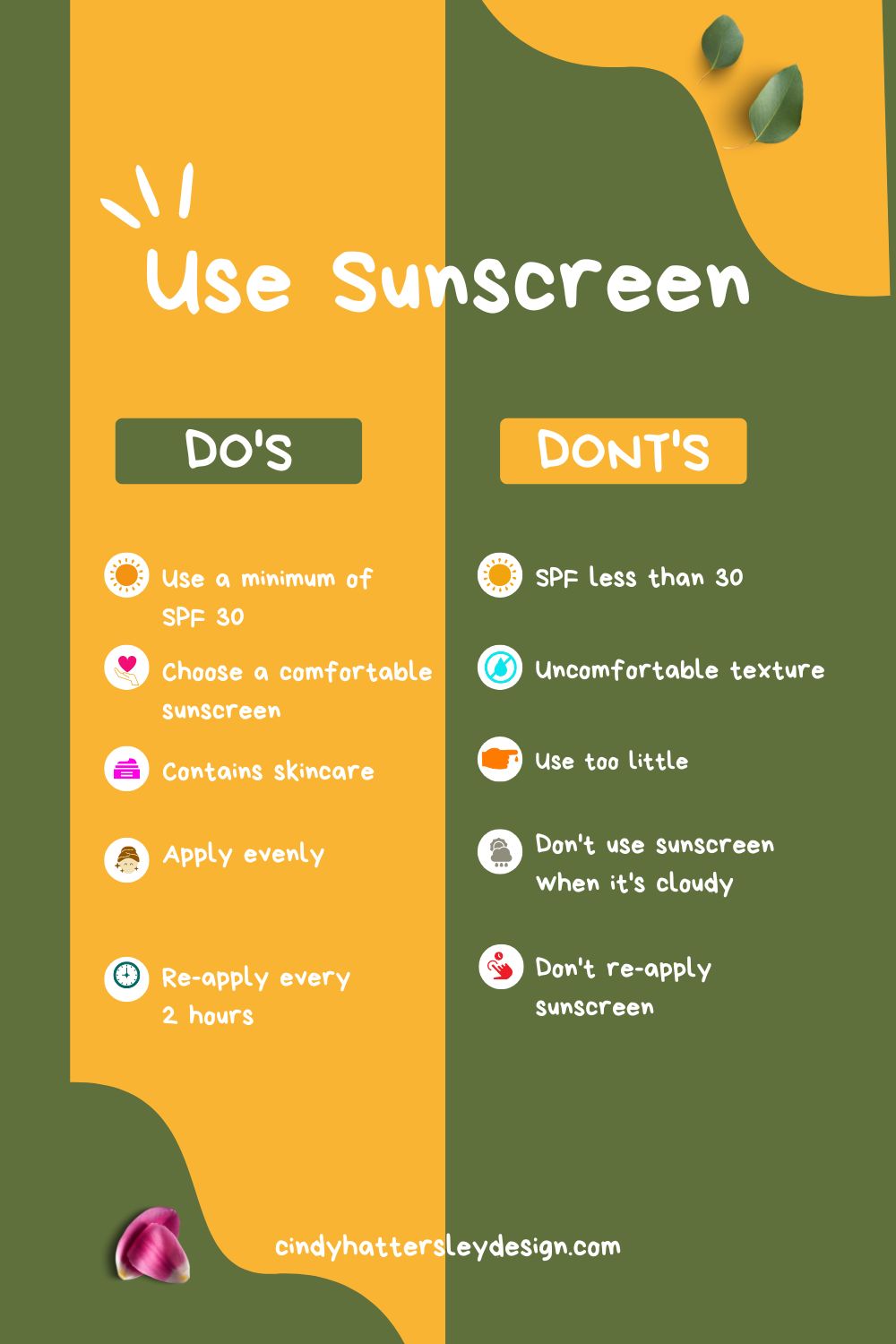
5 Essential Tips for Choosing the Best Sunscreen
Broad-spectrum sunscreens come in various formulations to cater to different skin types, preferences, and needs. The most common types include lotions, creams, gels, sprays, sticks, and powders. Lotions and creams are popular for their moisturizing properties and are suitable for dry skin. Gels, often alcohol-based, are preferred for oily or acne-prone skin due to their lightweight and non-greasy texture. Sprays offer easy application, especially for hard-to-reach areas, but require careful use to ensure even coverage. Stick sunscreens are convenient for targeted application on the face and are often mess-free. Powders provide a matte finish, making them ideal for touch-ups over makeup. Each formulation often contains different active ingredients, such as mineral (physical) blockers like zinc oxide and titanium dioxide or chemical absorbers like avobenzone and octocrylene, to protect against harmful UV rays
Know Your SPF
The American academy of Dermatology recommends using a broad-spectrum protection sunscreen with an sun protection factor of at least 30, which blocks 97% of the sun’s UVB rays. Higher-number SPFs block slightly more of the sun’s UVB rays, but no sunscreen can block all of the sun’s UVB rays so be mindful.
Consider your Skin Type
You need a broad spectrum sunscreen that protects from UVA and UVB rays that is waterproof. Is your skin oily, dry, or sensitive? Choose the proper sunscreen that best serves your type. If your skin is oily mineral-based sunscreens that contain zinc oxide and titanium oxide—these sit on the skin without increasing skin oil production. You can also opt for matte-finished sunscreens, which contain oil-absorbing ingredients like dimethicone and non-nano zinc oxide

5 Essential Tips for Choosing the Best Sunscreen
Chemical or Mineral?
The two main types of sunscreen are physical (mineral) and chemical. A physical sunscreen acts as a shield, deflecting and/or scattering ultraviolet (UV) rays. It sits on the surface of the skin. Chemical sunscreens act like a sponge, absorbing UV rays and converting them to heat which is then released from the skin. The American Academy of Dermatologists has a great article on sunscreen tips here.
Check the Ingredients
The FDA considers oxybenzone,aminobenzoic acid and trolamine salicylate as unsafe Ingredients. You may also want to avoid some of the ingredients below depending on your skin issues:
- Oxybenzone a popular ingredient that can be damaging to sensitive skin and coral reefs, even in small amounts
- Octinoxate can cause rashes, skin allergies, and reproductive issues
- Homosalate an organic UV filter that can penetrate the skin and cause hormone disruption and toxic byproducts
- Avobenzone can cause allergic contact dermatitis and may break down when exposed to sunlight, reducing its effectiveness
- Retinyl palmitate a form of vitamin A that can increase skin sensitivity, irritation, and potentially cancer when exposed to sunlight
- Parabens some parabens, like Butylparaben, can bleach coral
- PABA can disrupt melanin formation, which can lead to uneven skin tone and discoloration
- Methylisothiazolinone can cause allergic reactions in some people, especially those with sensitive skin
5 Essential Tips for Choosing the Best Sunscreen
Oily Skin Sunscreen Recommendations
If you have oily or acne-prone skin mineral-based sunscreens that contain zinc oxide and titanium oxide are best. They sit on the skin without increasing skin oil production. You can also opt for matte-finished sunscreens, which contain oil-absorbing ingredients like dimethicone and non-nano zinc oxide.

LEFT TO RIGHT CLOCKWISE:
Supergoop Matte Screen, Elta MD UV Daily (my go to) they also have a tinted there is also a tinted version here (apparently touted by Hailey Bieber on tik tok), Eucerin Facial Sunscreen, Coola Daily Moisturizer, Ceravie (my husband loves this) La Roche Posay
DRY SKIN RECOMMENDATIONS
Mineral sunscreens are generally gentler on the skin and may be the preferred choice for those with dry skin. Mineral sunscreens use naturally-sourced minerals like zinc oxide and titanium dioxide to physically block UV rays. Chemical sunscreens work by absorbing UV light and converting it to heat.
If your skin is dry look for ingredients like glycerin, hyaluronic acid, aloe vera, niacinamide, shea butter, cocoa butter, jojoba oil, almond oil, panthenol, and others. Emollients help to soften and smooth the skin and provide hydration to dry skin.
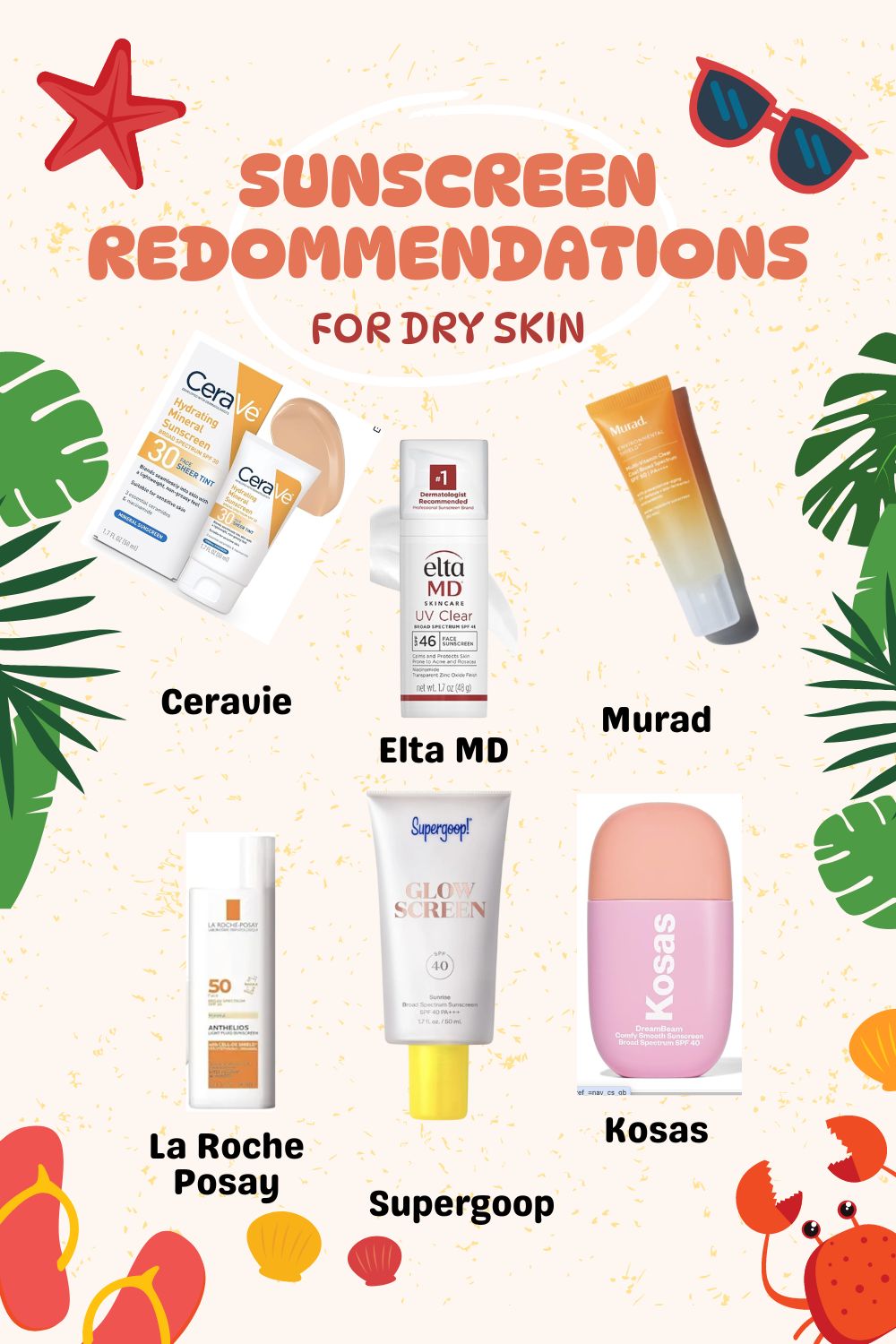
LEFT TO RIGHT CLOCKWISE:
Ceravie Hydrating Mineral Sunscreen,Elta MD UV Daily (my go to), Murad Multi Vitamin Clear Coat, La Roche Posay Mineral Ultra Light Face Sunscreen, Supergoop Glow Screen, Kosas Dream Beam
You can find Amazon’s highest rated sunscreens here.
Cosmopolitan’s 15 Best Sunscreens for Sensitive Skin
Glamour’s Ten Best Sunscreens for Dry Skin
Prevention Best Sunscreens for all Skin Types
Be Smart
Shade is your best friend. Avoid the sun during peak hours to avoid further skin aging. Typically, the intensity of sunlight is greatest in the middle of the day (typically between 10 and 4 depending on where you live), “when the sun’s intensity is an average of 1,000 watts of photovoltaic power per square meter”. To avoid premature aging wear protective Clothing (such as a wide-brimmed hat) and Sunglasses. Don’t forget your lips. Reapply sunscreen every two hours or after swimming or sweating. Check your skin regularly. Opt for a self tanner or bronzer if you want that sun kissed look without the sun exposure.
If you are searching for sunscreen, I hope you found this post 5 Essential Tips for Choosing the Best Sunscreen helpful. Many of the really good sunscreens are on all the lists. There are so many good options available now to protect you from the sun’s harmful rays and premature skin ageing.
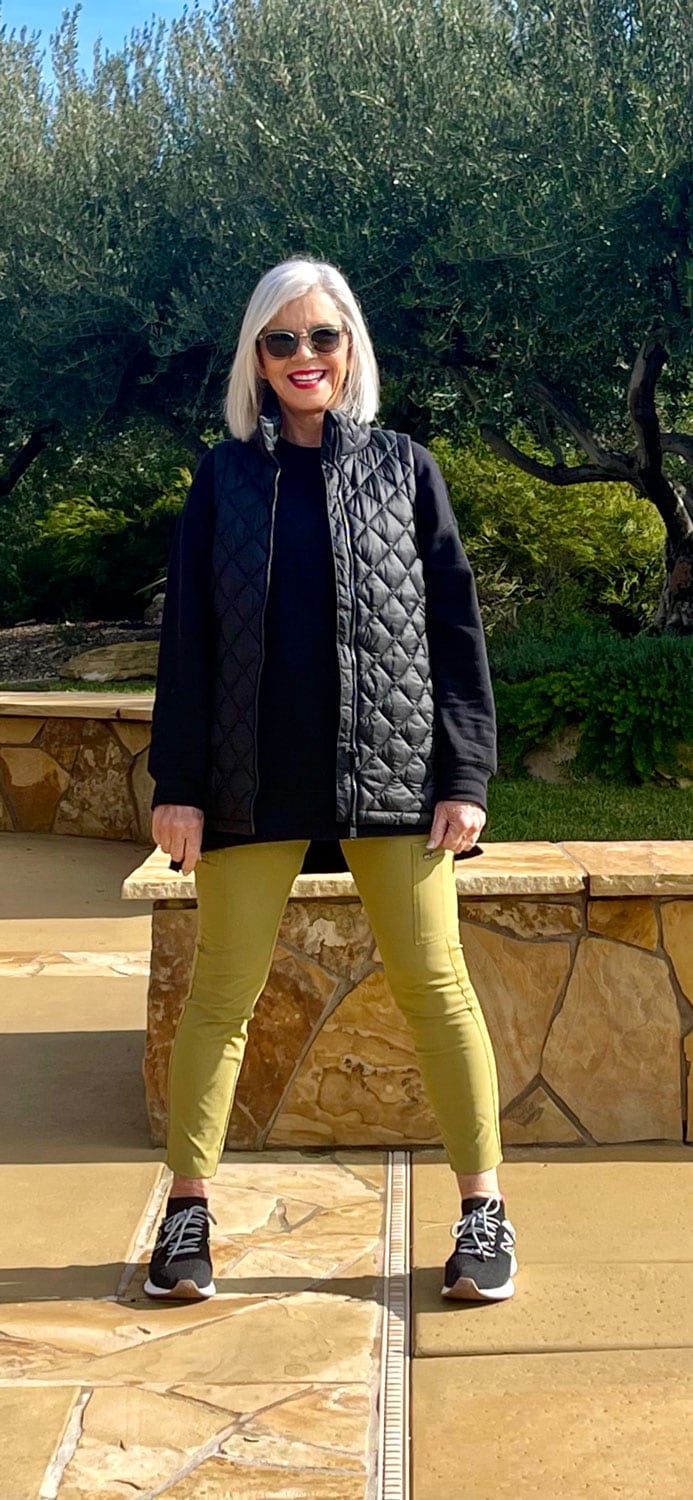




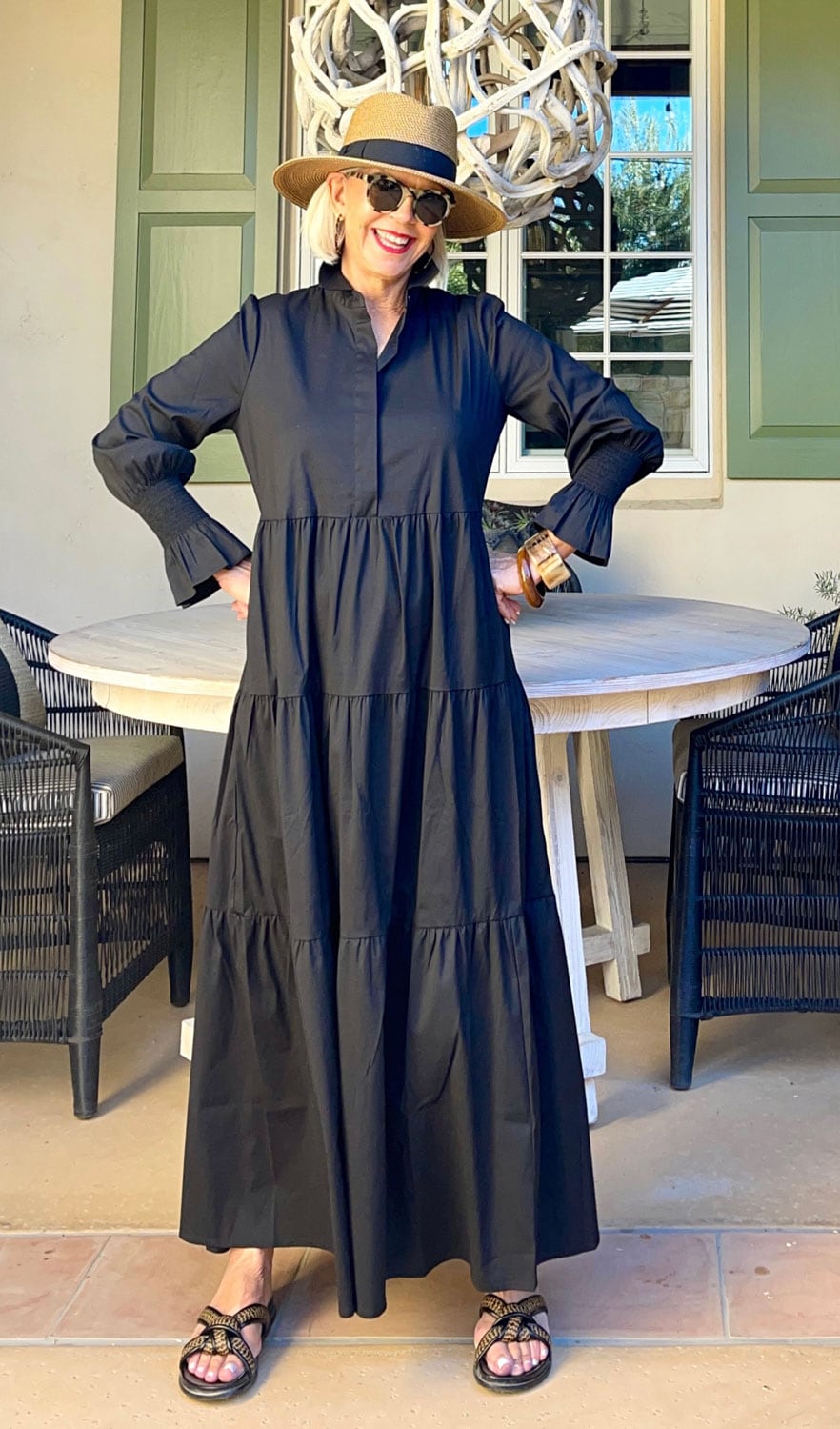
Where can I find the Black tired dress you are wearing just before your “BE SMART COLUMN”.
Hi Phyllis
Unfortunately that was from Chicos last year. This one is very similar https://rstyle.me/+h9t7Ks1kkwdbiSdwGiNMlQ
Cindy! This is so well researched! So much to think about and consider!
Thanks Annie!
Hi Cindy
Great information on
Sunscreen. Thanks!
Question, do you have a source for the white outfit you are wearing next to the yellow flowers at the top of your page?
Hi Judy
Here you go
https://rstyle.me/+OZJu0icjvup1o1LCyeQ_3Q
I’m Australian and grew up on beaches. At 72, I still adore the beach despite numerous skin cancers – basal and squamous and two years ago, had a 1/3 of the lip of my ear removed. I’ve been wearing sunscreen and hats for 40 years but the damage was done in my youth. I have freckles everywhere – some sinister, some not.
These days, I use a Factor 50 from our national Cancer Council, reapplied every single time I go in the water from nose to toes, even if it was only 20 minutes before. I obviously wear a brimmed hat and I cover in a long-sleeved men’s linen shirt with a pop-up collar whilst sitting on the beach and always try to sit in the shade.
Last summer I purchased some gorgeous swimwear with short little sleeves and a high back. But I love all my swimsuits and others are not as good for covering up. I’m a lover of swimming in the ocean all year round – in summer that could be on and off all day, but I just follow the ‘slip,slop, slap’ rule Rita mentioned and get checked by a skin specialist twice a year. And hope for the best…
Hi Prue
Thanks for weighing in. I too suffer from years of baking in the sun!
I have had numerous bouts with facial and scalp keratoses, basal and squamous skin cancers and 3 Mohs surgeries, one on my scalp which was a nightmare. At my dermatologist’s recommendation I began using Isdin sunblock. From their website:
Eryfotona Actinica is an ultralight, fast-absorbing emulsion providing all-mineral broad spectrum sun protection for daily use. Its innovative formula contains patented DNA Repairsomes®, clinically proven to help repair existing sun damage. It is thin and easy to apply and fine under makeup. I’ve been very pleased with it….of course , for the head I’m always in a hat outdoors.
Hi Susan, which Isdin product do you use? There are so many to choose from…..some better value than others. Regards Lisa
I’m Australian and I grew up with ads on TV and in magazines with the slogan ‘Slip, Slop, Slap. Slip on a shirt, slap on sunscreen and slop on a hat.
I love that Rita!! There was no such thing as sunscreen when I was young!
At 50 my Internist informed I should wear a sunblock everyday, especially since I was headed to Thailand. Had no clue what to buy. I’m a women of color with no background in sunblocks. And, I’d thought my skin tone was a genetic sunblock. The store pharmacist helped me. The product made me look like I’d fallen into a vat of flour and it broke me out. Never used it again. Years later in a dermatologist office trained in skin of color and sensitive skin, was informed my skin is delicate and that I had loads of skin damage from the sun. Also, learned most OTC sunblocks are formulated for fair skin which explains why I had the flour on the face look. She recommended products for skin of color and/or anyone with sensitive skin as follows: Start the day with – Neutrogena Healthy Defense Daily Moisturizer with SPF 50. To refresh protection – Colorscience Sunforgettable Total Protection Brush On Shield GLOW SPF 50. The latter product is sold in various colors. Neither breaks me out or cloaks my skin in a veil of white.
Also, wear at wide brimmed hat. Thanks for all the good information.
Great idea! I also like to wear SPF shirts, plus UV sun protection sleeves when working outside.
Hi Cindy, can you check your charts? In the don’t column, you say “don’t wear sunscreen if it’s cloudy” and “don’t reapply sunscreen”
Am I reading that incorrectly? It’s a bit confusing. Seems obvious that those are do’s!
Also, I would add that clothing with SPF is great for outdoor activities, such as hiking, gardening, and swimming. My Columbia PFG shirt is cool and comfortable, and offers good sun protection. Same goes with rash guards over swimsuits.
Real life dressing can be far more utilitarian than dressing for vacation, strolling, and dining out.
Ha! That is not my chart but it is a bit confusing …reread it and it makes sense! It is a double don’t …confusing I know. I did the same thing.
I like to use Trader Joe’s knock off version of Supergoop! at 1/4 the price. They are very similar.
Thank you for listing ingredients and some of the negative effects of them.
I also worshipped the sun when I was young. I have been switching over to long sleeves more and more to avoid sun exposure on my arms. The clothing manufacturers have been using lighter fabrics in the last several years like cotton voile so clothing feels cooler and you benefit from sun protection.
Cheryl
For those where it’s available, Kroger’s has a Super Goop dupe, as well.
Good to know Elaine!
EWG is another great resource for safe sunscreen
Hi Linda
Thanks I will check it out!
great info as always Cindy. I’m a HUGE fan of Elta MD and SPF sun shirts!