
The Enchanting Gardens of Dominique Lafourcade: French Garden Design at Its Most Beautiful

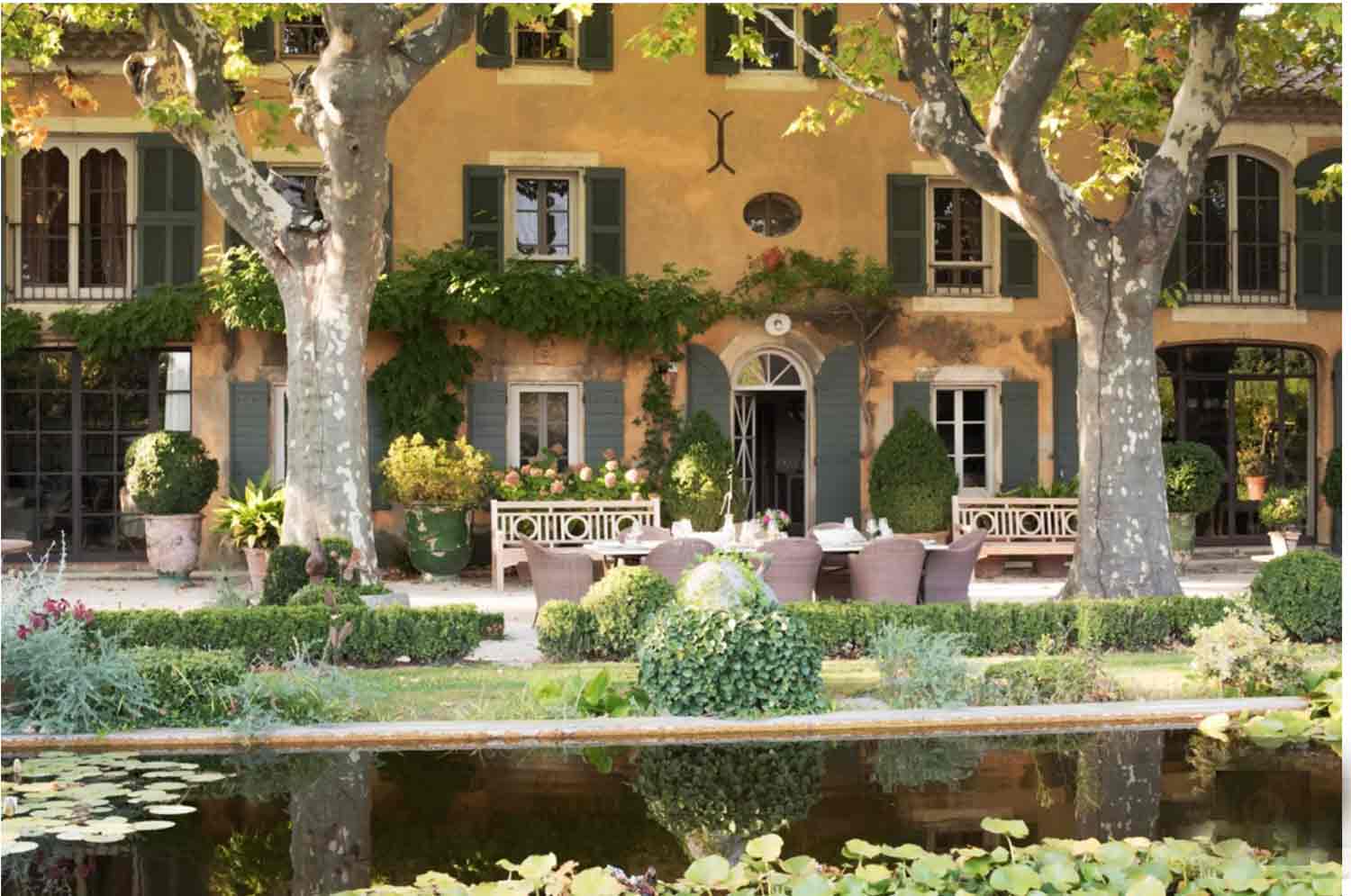
When a French Landscape Designer Changes the Way You See Gardens
Since we are traveling to Beaune France tomorrow, and then on to Provence, my mind inevitably drifts to french gardens and how much I love that style. I start pulling out my dog-eared garden books, lingering over photographs of gardens I have featured over the years and dreaming about what we might see in Provence. And when I think about the French garden design that has genuinely shaped my eye over the decades, one name rises to the top every single time: Dominique Lafourcade, the celebrated French landscape designer based in Provence whose work is, simply put, amazing. I penned the original of this post back in 2012 and it is still on of my personal favorites. I decided to dust it off and repost it. Let’s chat about The Enchanting Gardens of Dominique Lafourcade: French Garden Design at Its Most Beautiful.
If you love Provençal gardens (the structured beauty, the generous use of gravel, the sense that a garden is as carefully composed as a painting) then Lafourcade’s work will stop you in your tracks. It stopped me years ago, and I haven’t fully recovered since. I first encountered her gardens in her book Jardins & Bouquets (yes, entirely in French, and yes, I bought it anyway). I didn’t know her name yet, but I knew her gardens. That sense of space, restraint, and absolute mastery of Provençal garden design was unmistakable.
Living here in Paso, which has a similar dry-summer climate to Provence, her philosophy feels more relevant to me than ever. I used her approach in my former Chualar garden. There I should have chosen wider paths, more gravel, fewer plants fighting their environment, and far more structure. Live and learn, right?
Who Is Dominique Lafourcade? A French Garden Designer Rooted in Provence
Dominique Lafourcade is one of France’s most respected garden and landscape designers, based in Saint-Rémy-de-Provence in the South of France. She has spent decades creating formal French gardens and naturalistic Provençal landscapes that feel simultaneously timeless and deeply connected to their surroundings. Her design philosophy — that a garden is, above all, a work of art, runs through every project she’s ever touched.
“A garden is first and foremost a work of art, with the gardener playing the roles of architect, sculptor, musician, and painter in turn. A garden should move visitors, setting all their senses aquiver.” — Dominique Lafourcade
For many years, Dominique worked alongside her husband Bruno Lafourcade, a self-taught architect who became renowned his sensitive restorations of historic Provençal homes. Together they were a formidable team.Bruno brought architectural bones and historical knowledge to each project; she wove gardens around them that felt as if they’d always been there. Tragically, Bruno passed away unexpectedly in 2016.
I believe Dominique continues her work in partnership with her son Alexandre Lafourcade, who is also self-taught and began working with his father Bruno at just fifteen years old. Alexandre took over the architectural practice in 2012 after twenty-five years of experience on large-scale projects. The family legacy is very much alive, and very much worth following on their website here.
Their collaborative body of work is beautifully documented in the book Lafourcade, available on Amazon, which I’ve already ordered. Garden books, as I always say, rarely become dated.
Les Confines: The Crown Jewel of Lafourcade’s Provençal Garden Design
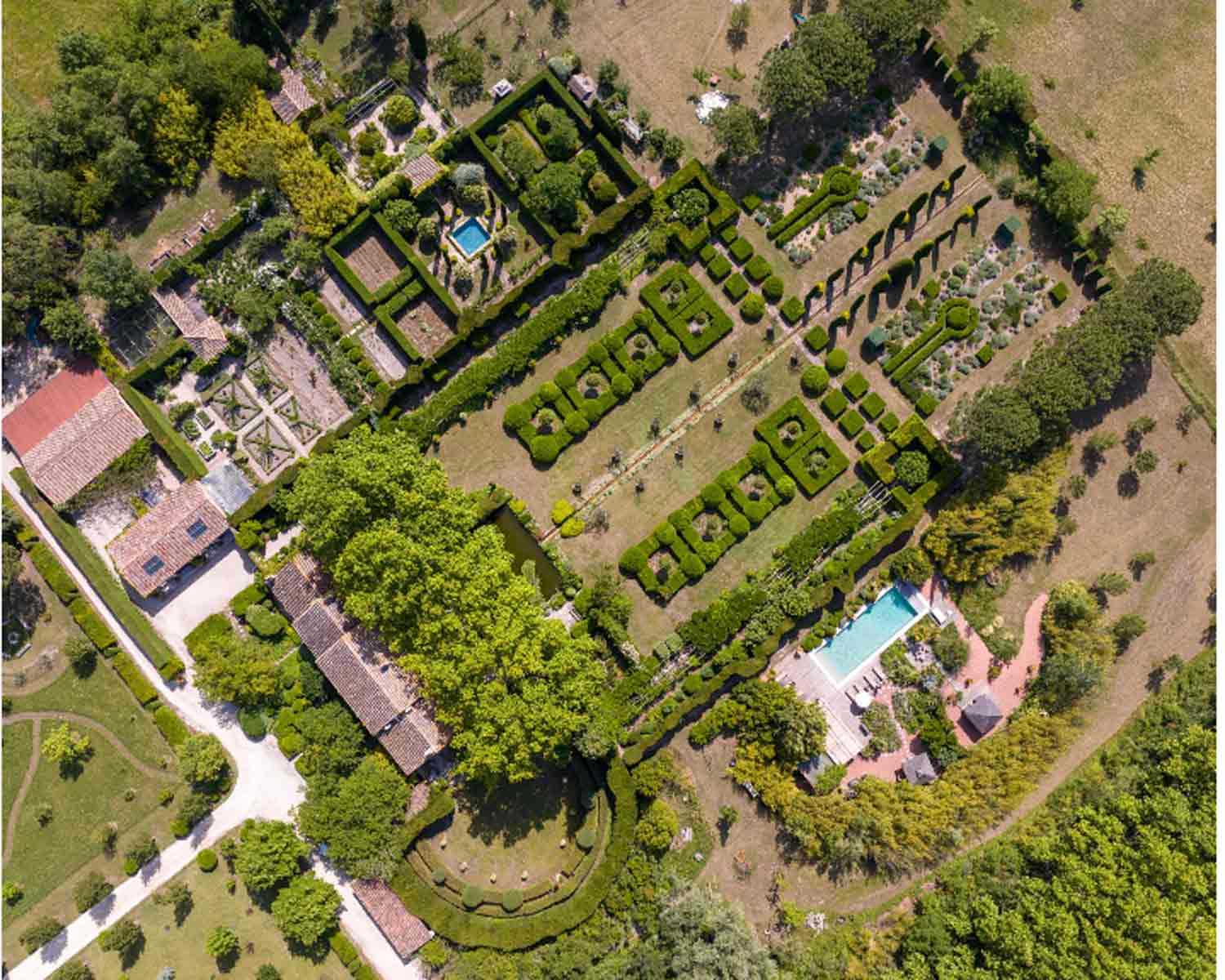
Perhaps the most famous example of Dominique Lafourcade’s French garden design is Les Confines, the breathtaking Provençal house and estate that she and Bruno created for their own family. Set within a twenty-acre private estate, Les Confines represents everything that makes formal French garden design so enduringly compelling: structure, scale, and a profound sense of place.
The aerial view of the estate is genuinely jaw-dropping. You can see the full vocabulary of classic French landscape design laid out before you: clipped formal parterres, long allées, kitchen gardens, pool gardens — each space distinct, yet the whole estate reading as a beautifully unified composition. I believe Les Confines is now available as a vacation rental, which means that lucky travelers can actually experience it firsthand. (Adding it to my list immediately.)
The Famous Olive Allée
One of the most photographed features of Les Confines is the allée of potted olive trees — a procession of silvery-leafed standards that creates instant structure and a very distinctly Provençal atmosphere. This is Lafourcade’s philosophy made visible: structure first, always. It’s something I wrote about in my post on the importance of structure in the garden, and it’s a lesson I return to again and again.
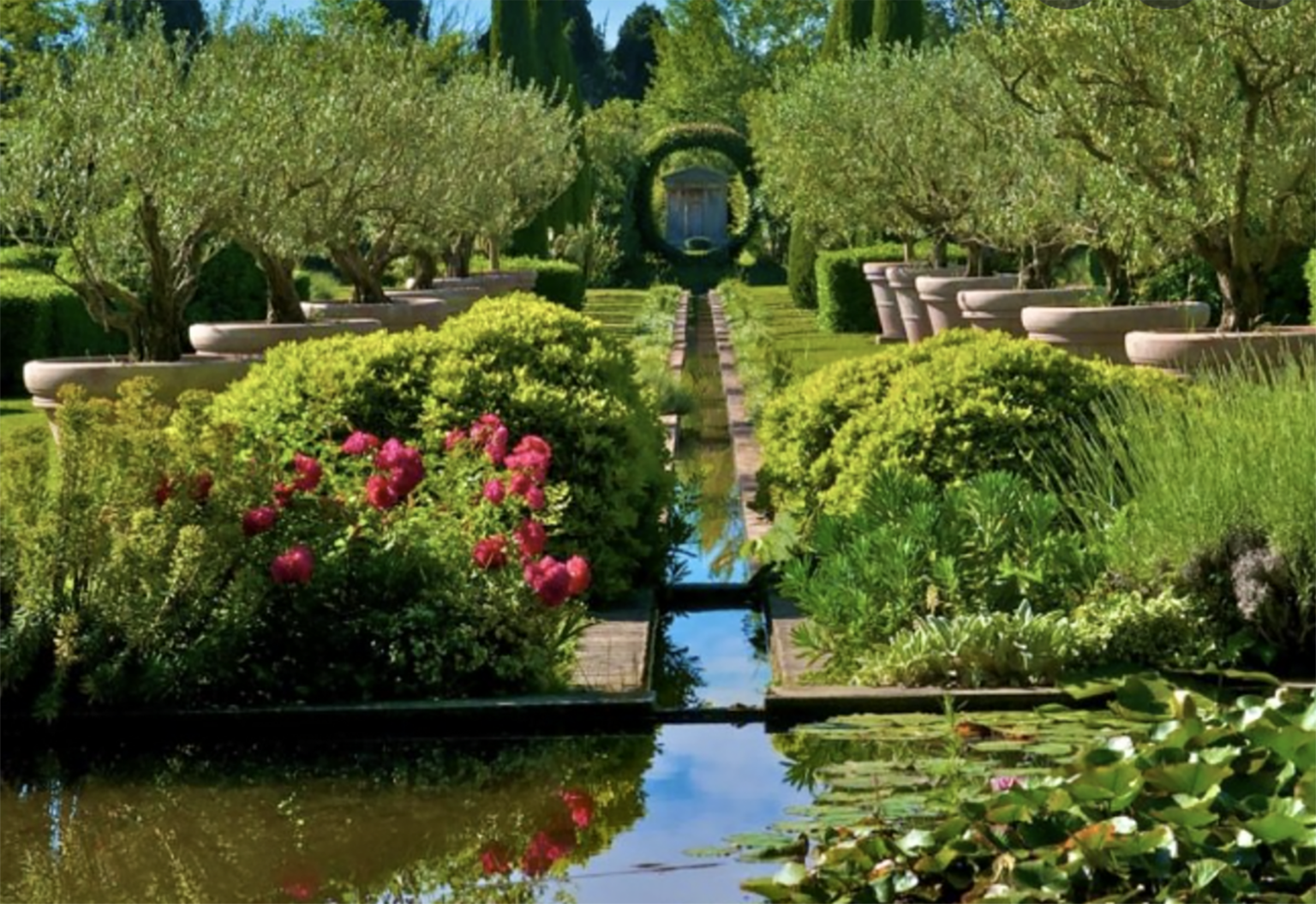
The famous allee’ of potted olives. Structure is so important in all of her designs. You might enjoy my post on the importance of structure in the garden here.
The Formal Garden, Kitchen Garden & Beyond
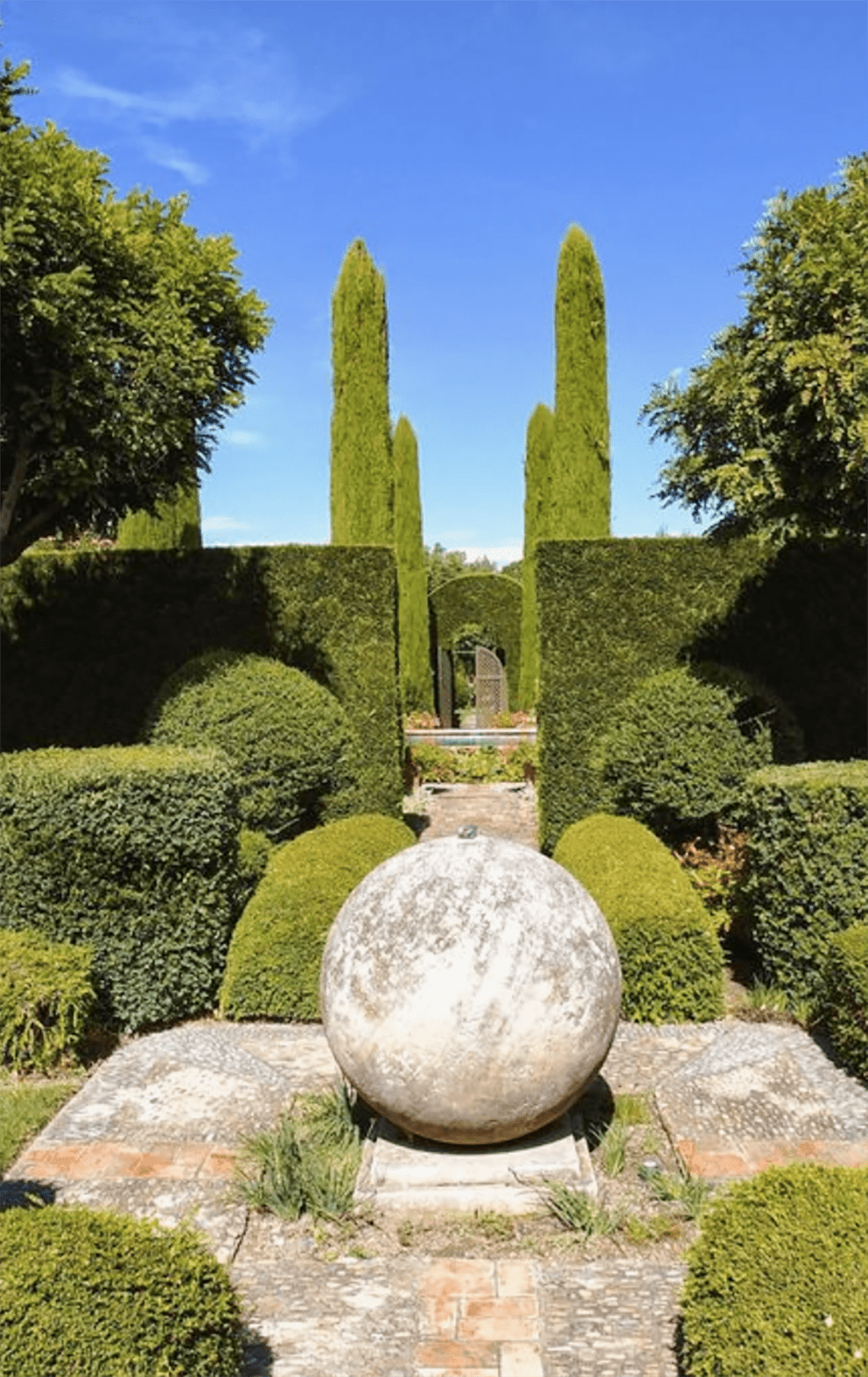
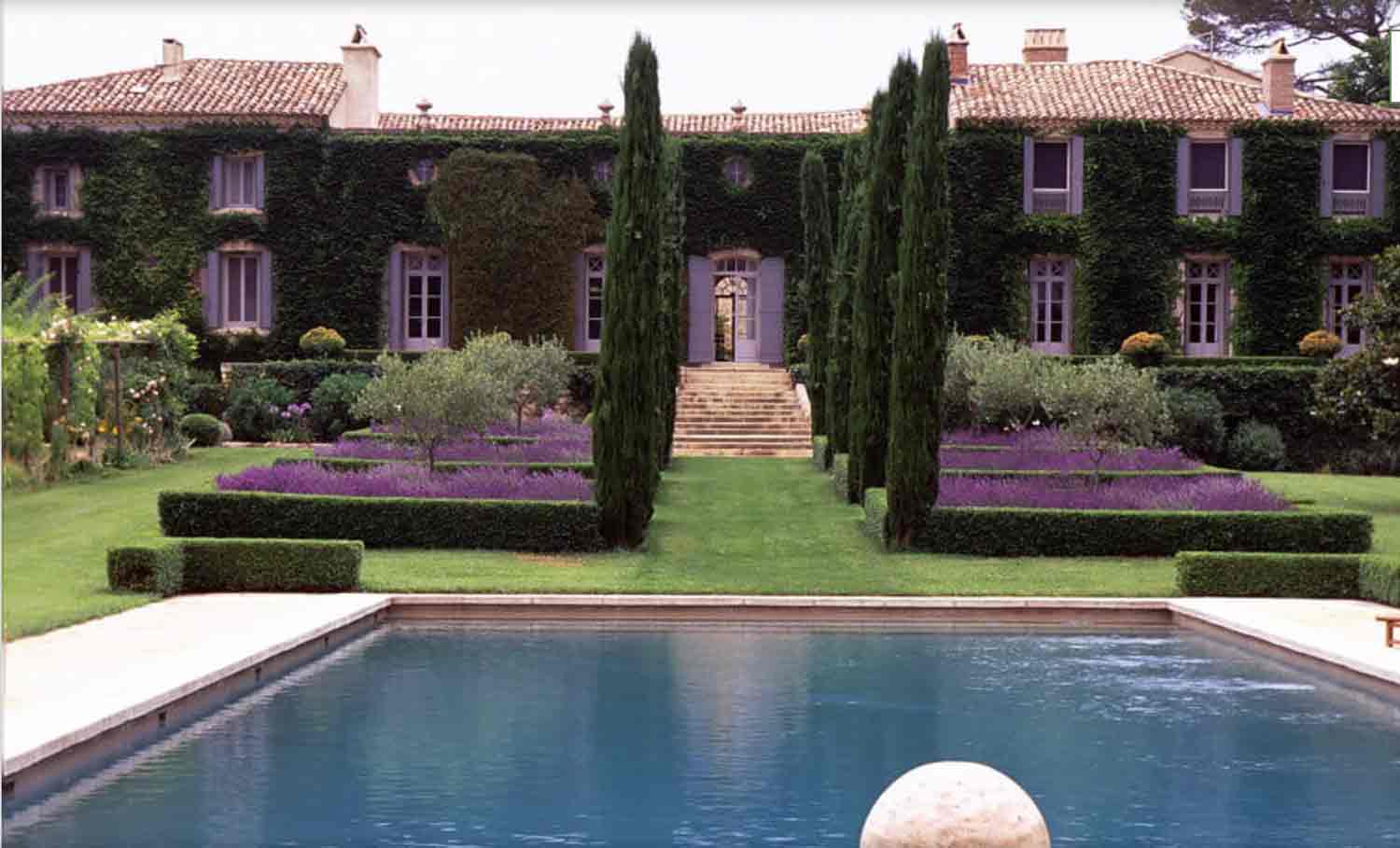
The formal garden at Les Confines features borders I believe are planted in box (buxus), with plane trees, what appears to be laurel, and Italian cypress providing height and drama in the background. It is the very definition of a formal French garden, ordered, architectural, and completely beautiful.
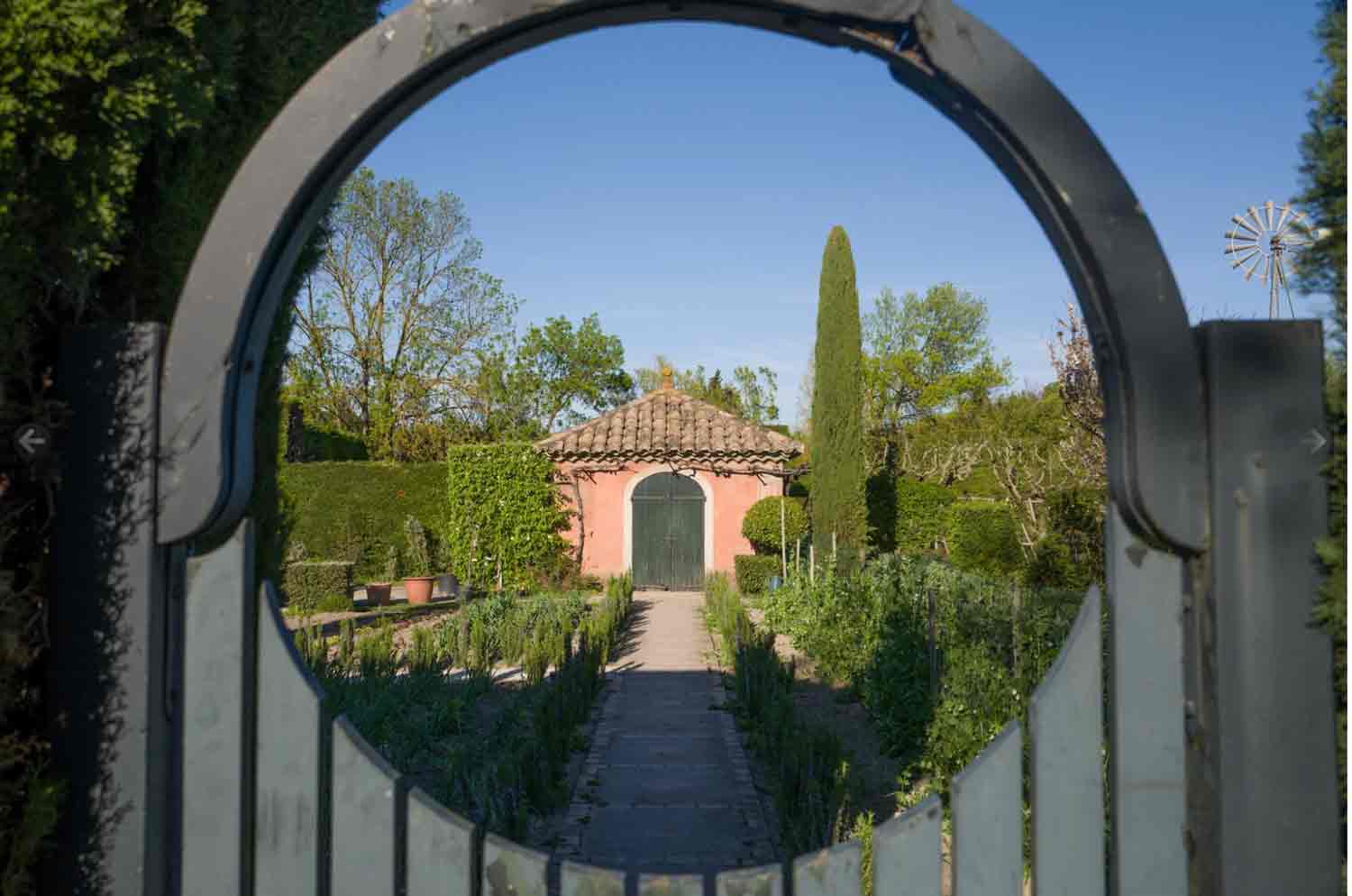
There’s also an extraordinarily beautiful kitchen garden, accessed through an ornate gate.
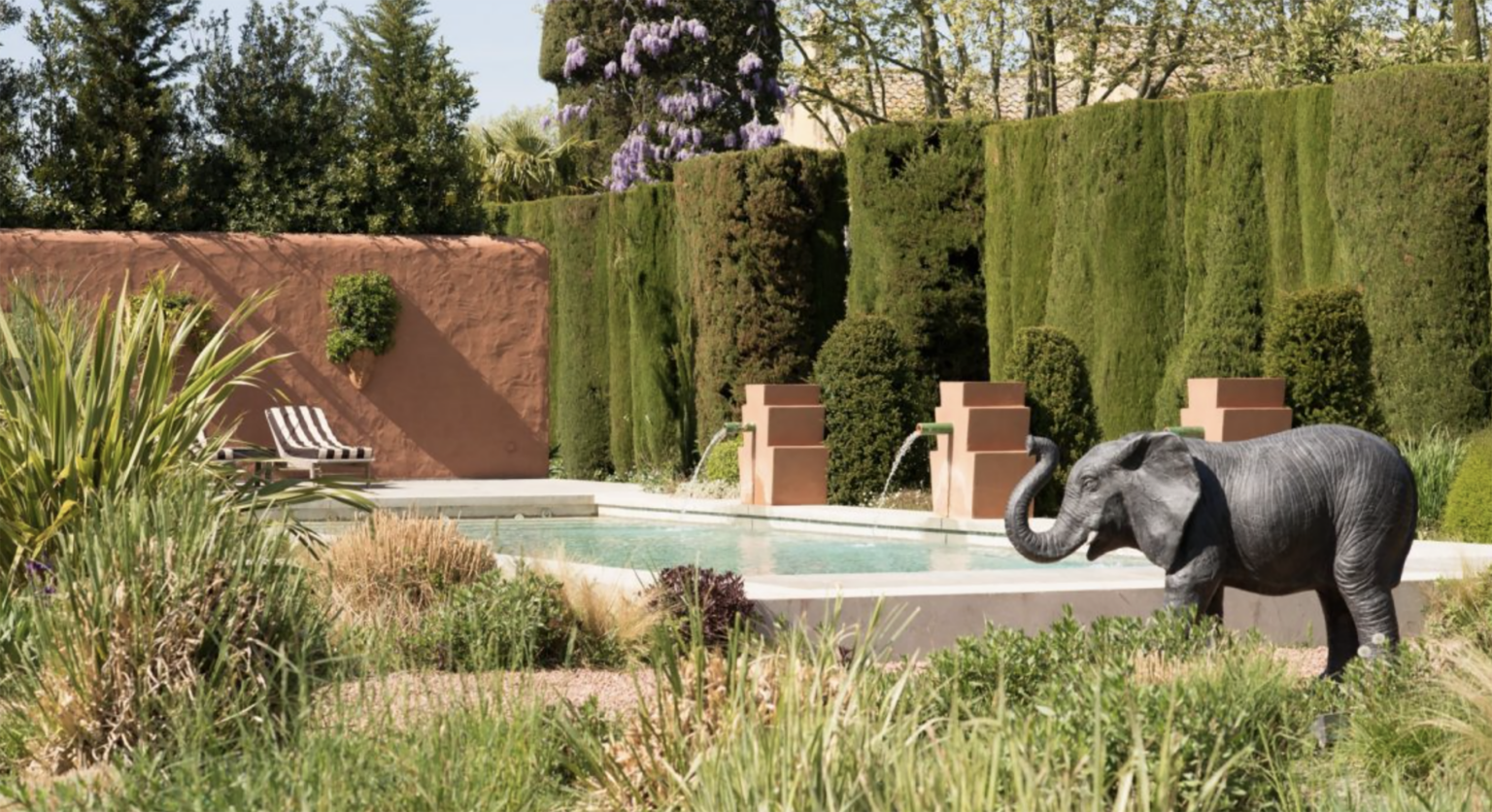
This is a detail that delights me most ,an African Pool Garden where Lafourcade planted grasses and drought-tolerant, arid-climate plants long before it became fashionable. She was ahead of the curve on water-wise planting.
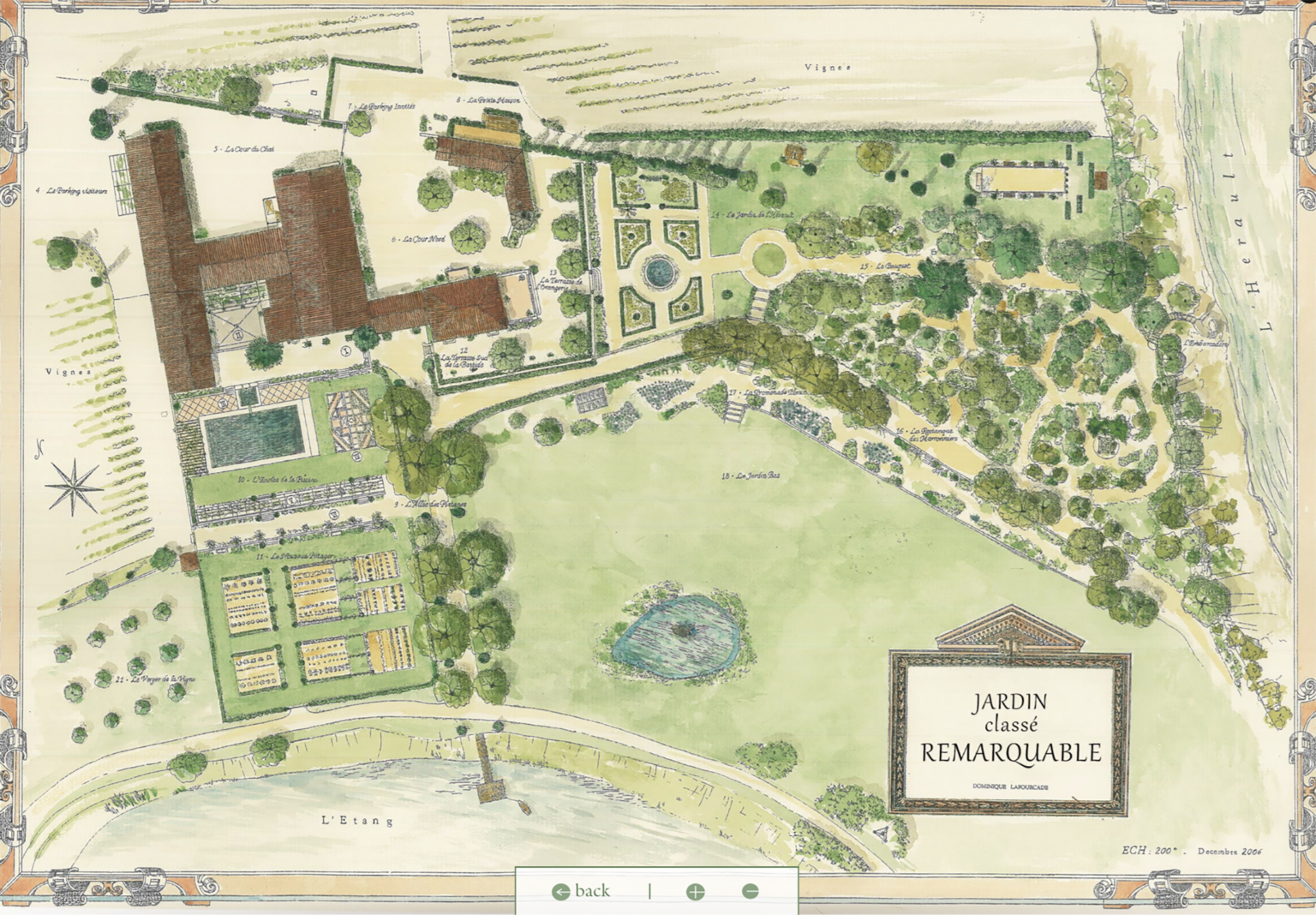
Her garden drawings are as beautiful as the finished designs themselves , another hallmark of a true design mind. You can explore the full portfolio of Dominique Lafourcade’s garden projects on her official website, where the breadth and range of her work is remarkable.
Mas de Baraquet: A Lafourcade Provençal Garden for an American Designer
One of the most widely photographed Lafourcade projects outside of her own family estate is Mas de Baraquet, the stunning Provençal garden she created for Atlanta and Newport-based designer Ginny Magher. It’s the kind of garden that makes you want to book a flight to France immediately — all billowing roses, perfectly proportioned pool terraces, and that ineffable sense of ease that the best French landscape design always achieves.
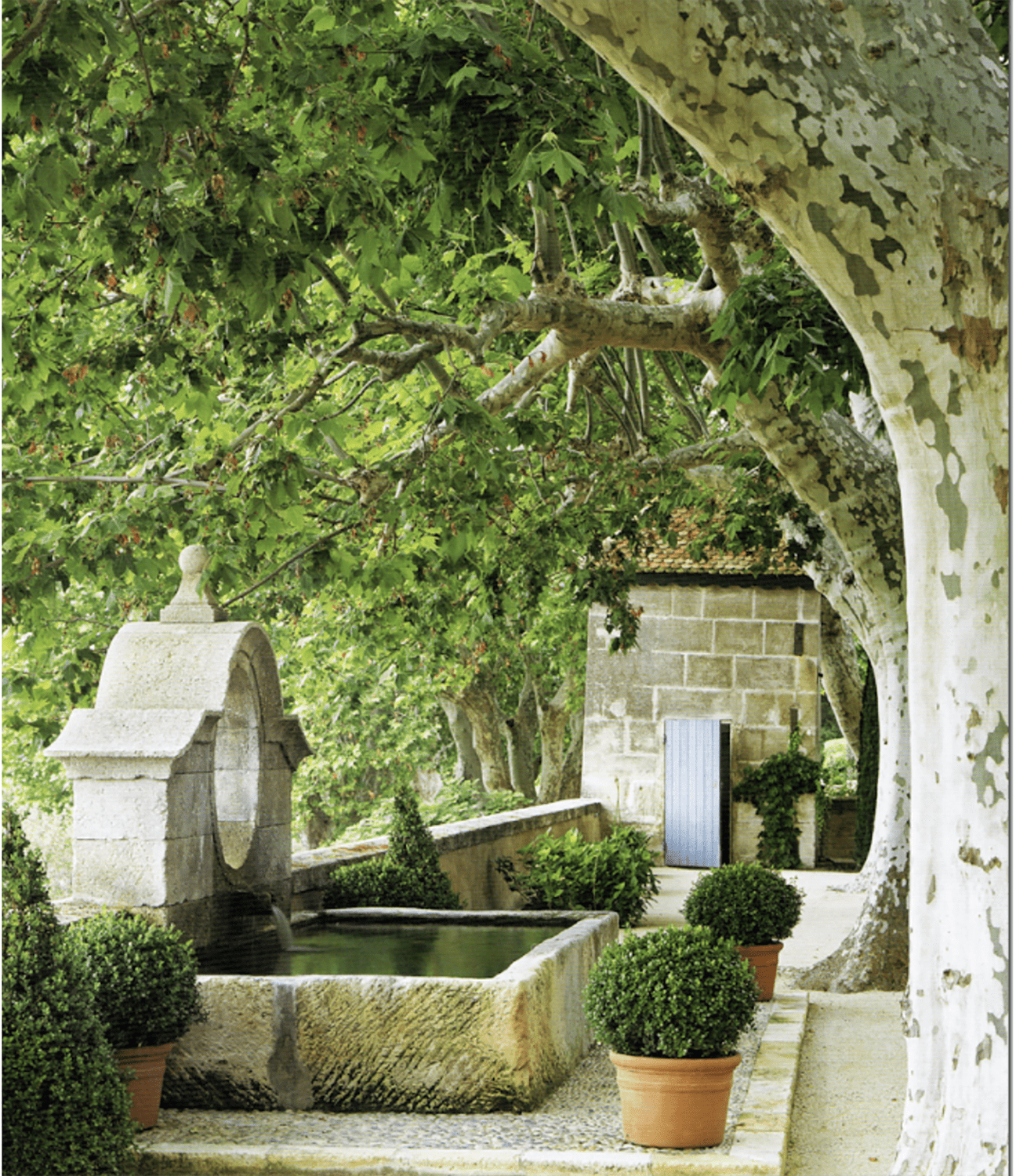
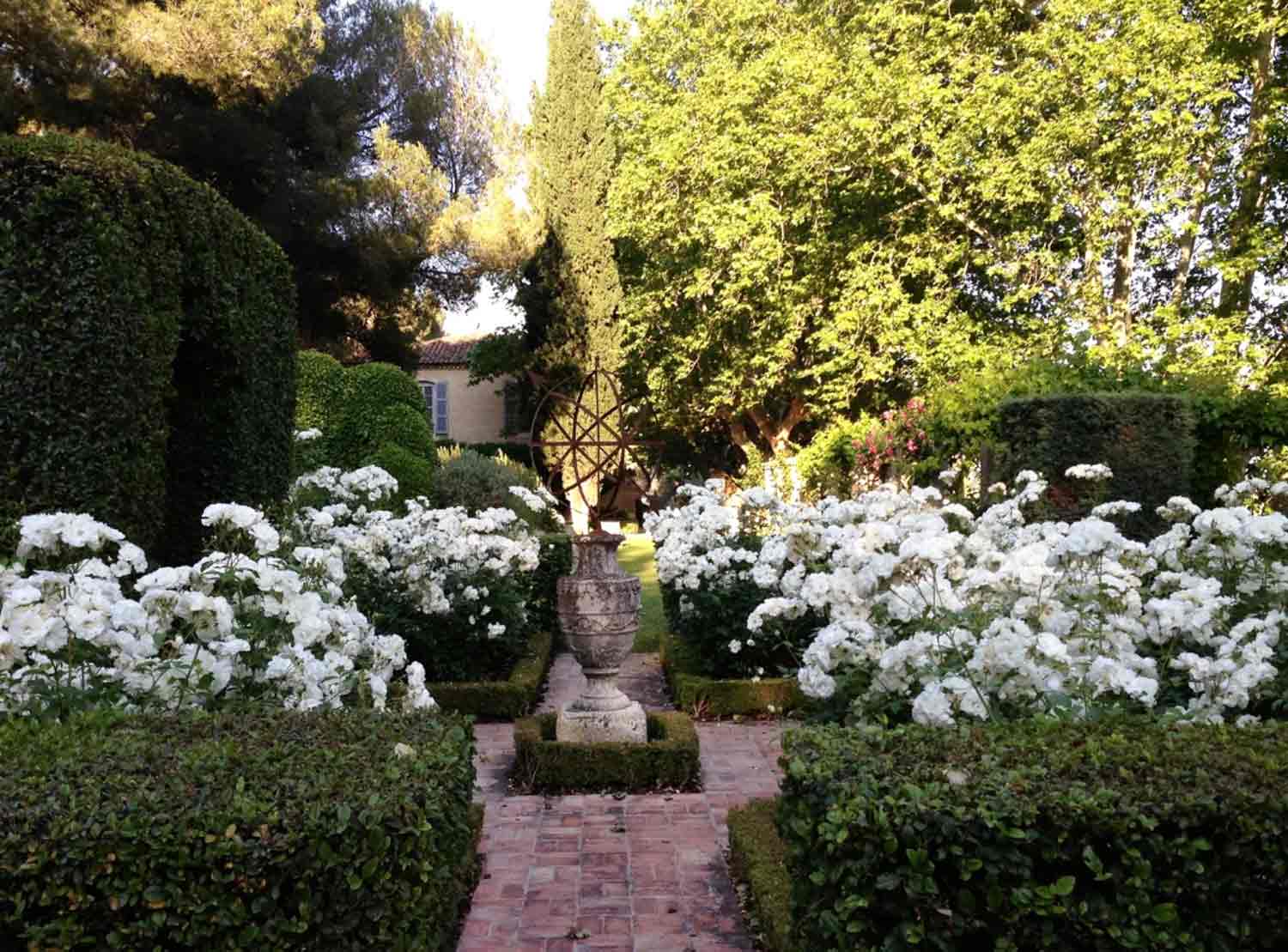
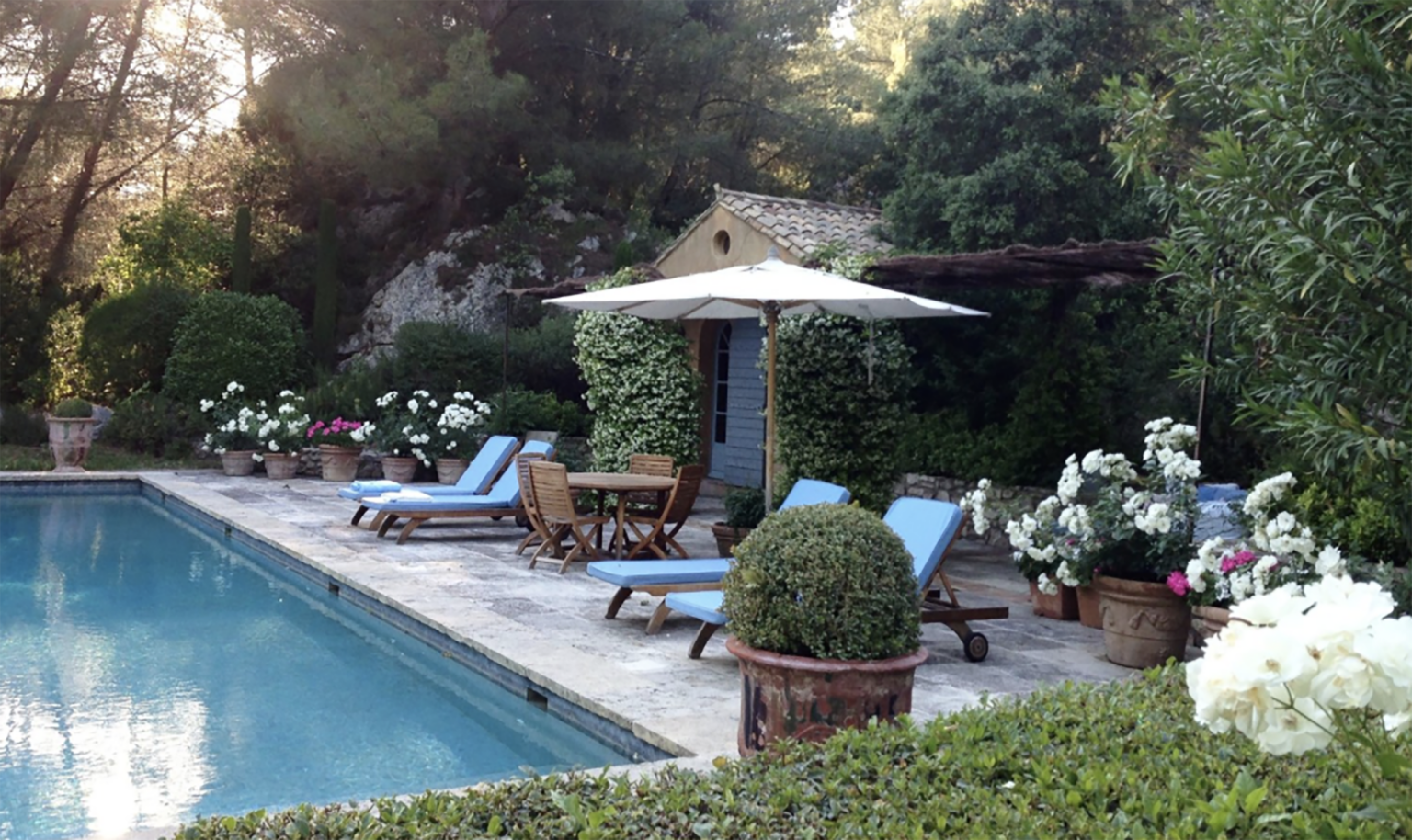
If you’d like to see more of Mas de Baraquet, Ginny shares it beautifully on her own website, and it’s well worth a visit. It’s a wonderful example of how Lafourcade’s approach translates beautifully even when the client brings an American sensibility to a French setting.
Les Mas de Poiriers: A Lafourcade Garden You Can Actually Stay In

Another Lafourcade project that has become a strong Instagram favorite is Les Mas de Poiriers, a Provence vacation rental in Saint-Rémy-de-Provence. You can actually book a stay there and wake up inside a Dominique Lafourcade-designed garden. The property was restored architecturally by Alexandre Lafourcade for an English couple who loved Provence so much they eventually made it their permanent home. (Can you blame them?)
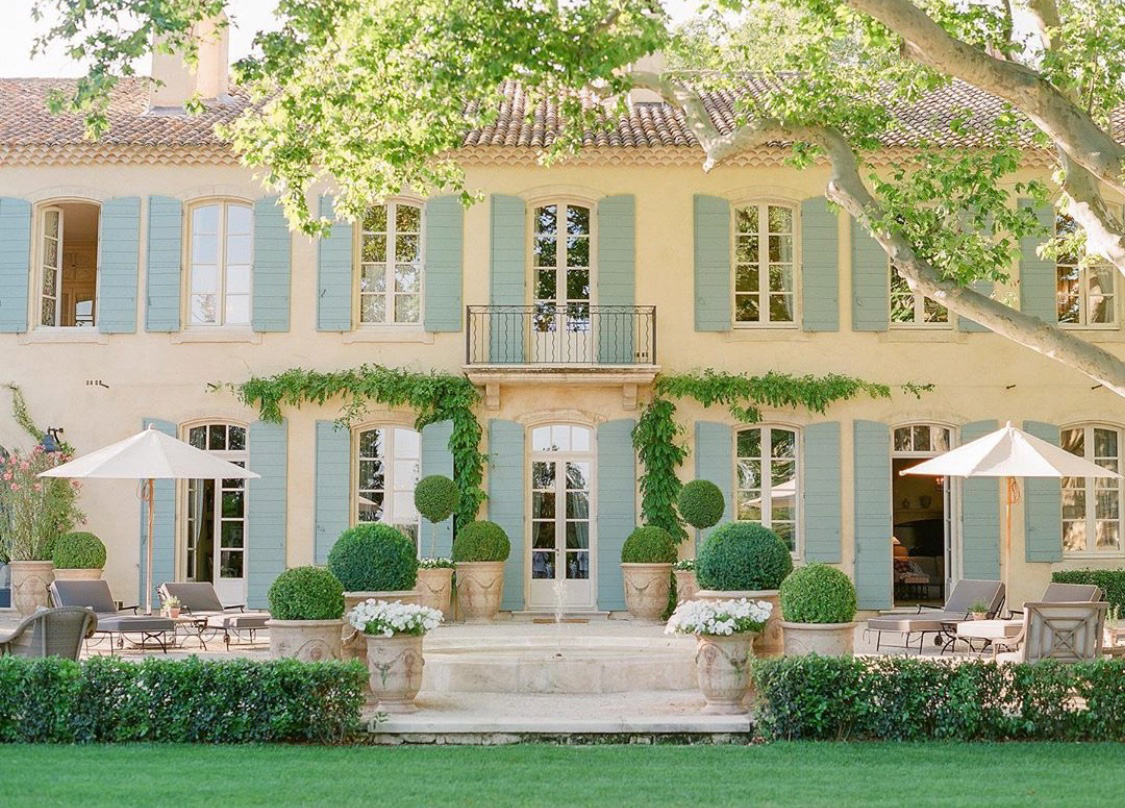
The owners have since written a gorgeous book about the property, Provence Style filled with beautiful imagery of both the stylish interiors and the garden spaces. It’s the kind of book you keep on your coffee table and reach for whenever you need a little visual refresh.
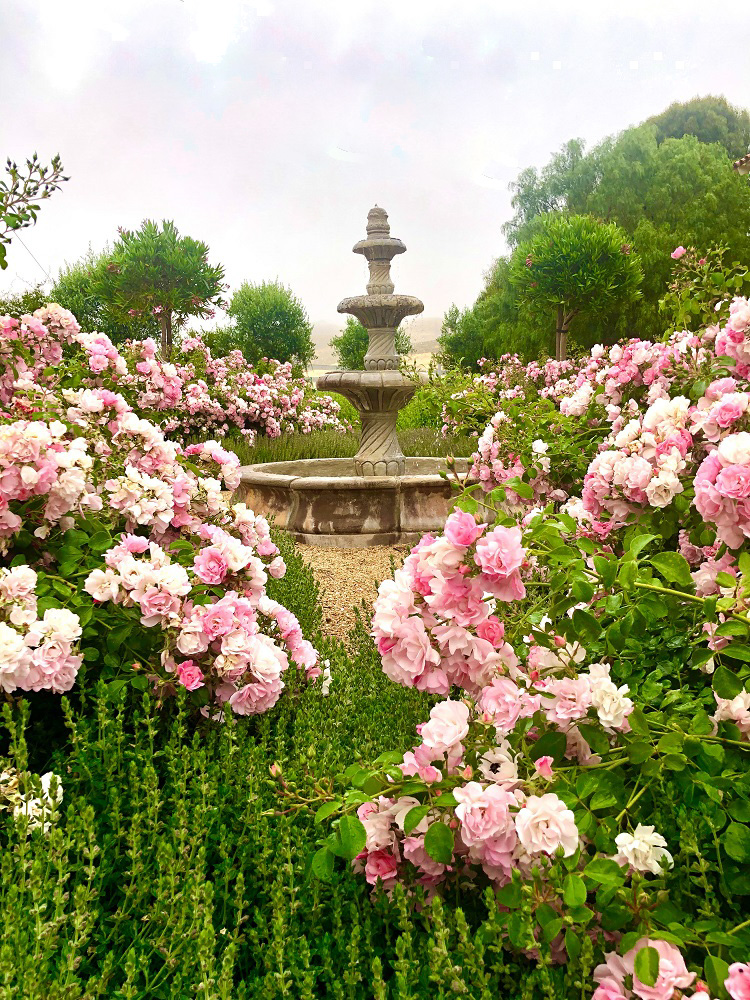
There is always, in a Lafourcade garden, a place that draws the eye to a point of rest. Whether it’s a bench at the end of a path, a fountain, a framed view. It’s one of those compositional instincts that separates a truly great garden designer from a good one. Every space invites you to pause.
I’m also charmed by her use of oleander hedging throughout this garden. Oleander is practically indestructible, it blooms for an exceptionally long season, and it adds that billowing Mediterranean softness that gravel-and-stone gardens need. (One important note: oleander is poisonous to both animals and humans, so it’s best suited to spaces where that’s not a concern.) I’m seriously considering adding more oleander to our own paso garden.
What Makes Dominique Lafourcade’s French Garden Design So Timeless?
Spending time with Lafourcade’s body of work — really sitting with it — reminds me why I fell in love with the French garden style in the first place. It’s not about having a large budget or a twenty-acre estate (though that doesn’t hurt). It’s about a set of design principles that work at almost any scale:
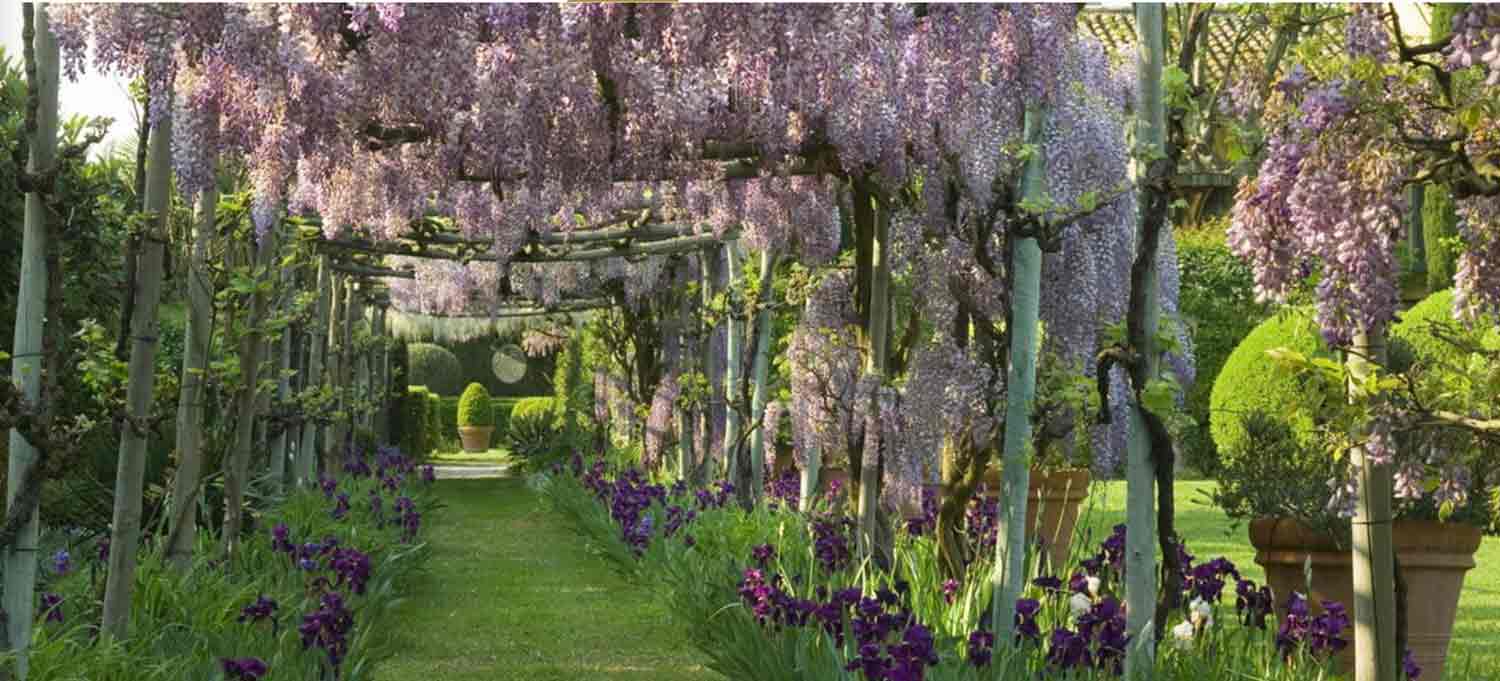
Structure first. Every Lafourcade garden begins with a strong architectural framework such as clipped hedges, allées, formal pools, defined paths. Ornament and planting come after.
Work with the climate, not against it. Her gardens in Provence use plants that thrive in that hot, dry environment. Grasses, lavender, olive trees, and cypress. No plants fighting for survival, but plants at home. This resonates deeply with me as I think about our own summer-dry garden here in central California.
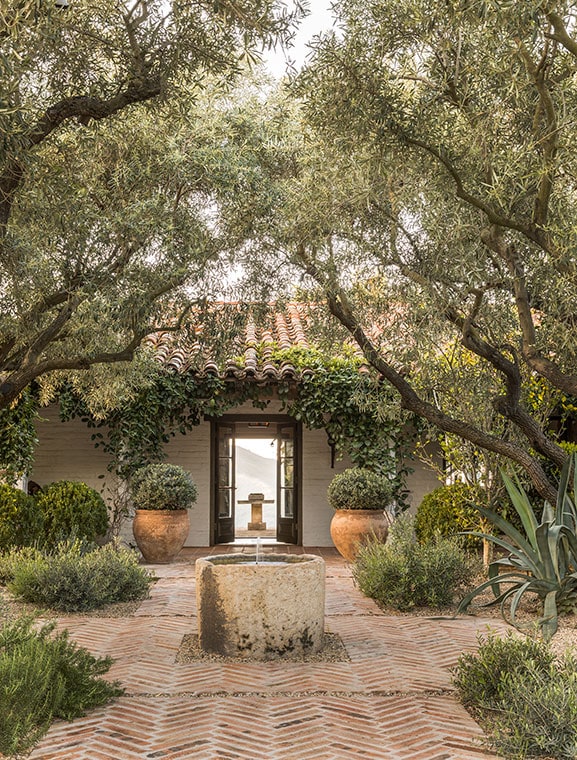
Gravel over grass. French garden style relies heavily on gravel. It islow-maintenance, water-wise, and it looks beautiful underplanting clipped topiaries and pots. I replaced grass with gravel in my former garden and I’ve never regretted it.
Wider paths than you think you need. This is the one I always wish I’d understood earlier. Generous paths are one of the hallmarks of great French landscape design. They can make even a modest garden feel considered and spacious.
The garden as total sensory experience. In Lafourcade’s own words: “A gardener must be an architect, sculptor, musician, and painter all at the same time for the result to move the viewer and appeal to all the senses.” That’s the standard she sets for herself, and you feel it in every project she’s created.
Books and Resources on Dominique Lafourcade & French Garden Style
If you want to go deeper into French garden design and Lafourcade’s work specifically, here are the books I personally own and recommend. Garden books rarely become dated
https://shopmy.us/collections/embed/4993101?“>http://https://shopmy.us/collections/embed/4993101?.
Further Reading:
Provence Post-20 Questions for Alexander LaFourcade
What my Garden has Taught me About how to Live
Before and After Backyard Garden Transformation
SHOP MY FAVORITE FRENCH GARDEN STYLE BOOKS

Closing Thoughts: Where My Heart Still Lives, Garden-Wise
Thank you for reading The Enchanting Gardens of Dominique Lafourcade: French Garden Design at Its Most Beautiful. I’m so glad I revisited this post. Spending time with Lafourcade’s work again has reminded me exactly where my heart is when it comes to garden design, and I am excited to visit some of the gardens I have long admired.
Thank you for reading f you find the French garden design philosophy as compelling as I do, I’d love to hear your thoughts in the comments. And if Dominique Lafourcade’s work is new to you, welcome to a rabbit hole you will thoroughly enjoy falling into.
Have a wonderful Tuesday from Paris!!
— Cindy

Cindy,
Such a great article!! I have seen these gardens in magazines and Pinterest and have always loved them. I just ordered the book!! I love to read how people plan out their gardens! I found your blog about 3 years ago snd it’s one of my favorites! I love your gardens at your old home and know Judy will transform your new place!!! Thanks fir re-writing this blog post!!
Xo martha
Hi Martha
This post was a favorite of mine as well but all the pictures had disappeared!
Cindy! This is making me want to visit Provence…but then I always want to travel, I cannot wait to see your garden and your new fountain!
I was just thinking how similar our climate is to Provence and why all these gardens feel like home. Colin and Lauren’s garden…OMG. And yours will be awesome too!
Hi Cindy
Oh I have so much to do. I can’t even imagine where to start, but you’ve shared such wonderful resources! The books are on my list. I will spend time perusing the accounts of the women you mentioned. Such lovely gardens. Make my heart beat faster!
Xo Heidi
If it were only true that you can’t kill an oleander. Here in southern California, a number of years ago, a disease took hold in the oleanders and destroyed many a find hedge. People used to living in privacy had to put up opaque fences. Oddly, the disease killed only one flower color (pink, I think) but spared others. As a child, I heard many horror stories about the poison–the boy who roasted his marshmallow on an oleander branch and died, etc,
SO ELEGANT!
TAKES ME BACK TO VACATIONS THERE WHEN WE LIVED IN ITALY!
I DIDNOT KNOW YOU READ TARA!!!!!!
I HAVE A CALL WITH HER TODAY!
I loved this. Can’t wait to pour over it again and learn more.
Cindy,
I do love the garden work of Dominique Lafourcade. I have so many of the images you’ve shared in my file. Your garden in your former home was lovely and one of my favorites as well. I’ll be eager to see what you plan for your smaller garden.
xo,
Karen
These are my favorite garden images! Elegant yet they lend themselves well to takeaways for our own gardens, large or small. Indiana? I lived there! Talk soon! xoxox, Brenda
ah. a girl can dream…
Cindy- I never put two and two together to realize that the house Joni posted was yours… it is wonderful!
I adore "round" and especially in the garden… and so many of these photographs had round in them- perfect in my book!
best,
joan
I want to thank all of you "seasoned" bloggers for taking the time to comment on my little blog..I so appreciate it. You so inspire me every day!!
Mesmerized is the right word for it – definitely! I loved hearing about your learnings about your garden too, since we are just settling in here in Seattle. For the most part it is not landscaped and wild with large evergreens (very Seattle-ish!), ferns and lush greenery. BTW I tried to see your house (it sounds lovely!) on Joni's blog but it said the page didn't exist. And yes, we are definitely on the same wavelength on our blogs. 🙂 Have a great long weekend!
Hello, How do I get in touch with you? There is no email or contact info listed .. please advise .. thanks .. Mary. Please contact me maryregency at gmail dot com
Beautiful post!
Cynthia Jorgensen
Thank you so much Cynthia for stopping by! I really appreciate it!
Simply gorgeous!!!
Shared this on my Facebook page for ME, ME, ME.
I'm somehow even mentioned? How?
Anyway. Have a written-in-French garden book too. Le Vasterival. By Princess Sturdza.
I understand every word. Don't know how, but I do.
This post is melting my heart. Wish it were a little book. I would buy it.
Garden & Be Well, XO Tara
Tara
You are my garden guru! I have learned so much from your posts and books! Thank you so much for stopping by!
Hello Cindy ~ Thank you for featuring Dominique Lafourcade! Truly one of the most talented and gifted garden designers! Yes, I have many of those images on my Pinterest boards 🙂
Your garden is beautiful, as I've mentioned before!! I, too, have a Spanish Colonial style house. And, I also planted santolina in our heavy clay soils….that didn't do well. I've replaced it with English Hidcote lavender, which has done well to my surprise.
Thanks for sharing your garden experience with us! I can relate 😉
Loi
Hi Loi
I have tried many different lavenders and the English versions do best in my garden as well. The Spanish get's woody and falls over, the provence seems to die out in clumps. In California Lavender is only supposed to last about seven years. However if you hack it back religiously three to four times a year it sometimes lasts much longer ! You are my Eastern Garden Guru! Love seeing and hearing about your garden! Cindy
I wonder where Santolina actually grows well…I have never seen it in good form!!
Definitely thrives in Provence and Southern Italy!! Anywhere hot and rocky, I think.